Some links in this post are affiliate links. When you buy through our links, we may earn a small commission — at no extra cost to you. We only recommend products we genuinely believe in. Read our disclosure policy.
The Real Problem With Shelf Dividers
You fold a stack of sweaters on the shelf, step back, and it looks organized. Three days later the pile has migrated six inches sideways, collapsed into the adjacent stack, and everything needs refolding. Shelf dividers exist precisely to stop that landslide — but here is what the product listings don’t tell you: a divider only works if it fits your shelf. Most metal and acrylic dividers are designed to clamp onto shelves that are exactly 3/4 inch thick, which is standard for melamine-coated particleboard and most plywood shelving. If your closet has wire shelves, those dividers will sit on top of the wire grid with nothing to grip and fall the moment you pull out a sweater. If your shelf is thicker than 3/4 inch — common in custom wood closets — the clamp slot won’t close. Buying the wrong divider means returning it. This guide starts with the measurement step that most articles skip.
Measure Your Shelf Thickness First
Before you look at a single product, grab a tape measure and check the edge of your shelf. Here is what each measurement means for your purchase decision.
Standard melamine or MDF board: 5/8″ to 3/4″. This is the most common shelf material in builder-grade and mid-range closet systems (IKEA PAX, ClosetMaid, most Home Depot wire-to-wood hybrids). Nearly every slot-style metal or acrylic divider on the market is designed for this thickness. Any of the three picks below will work.
Solid wood or plywood: 3/4″ to 1″. Thicker plywood shelves are common in custom closet builds and older homes. At 3/4 inch they work fine with standard dividers. At 1 inch, the clamp slot on most dividers won’t close — the divider will wobble. If your shelves are 1 inch thick, look specifically for dividers that list a maximum shelf thickness of 1 inch or more in the product specifications, or choose a clip-on style that doesn’t depend on clamping.
Wire shelves: N/A for slot dividers. Wire shelves (the white or chrome coated wire grid shelves found in most rental apartments and builder closets) have no flat surface for a slot divider to grip. They require wire-specific clip-on dividers that hook directly onto the wire rungs. Trying to use a standard slot divider on a wire shelf is the number one mistake people make — and why so many returns happen. See our third pick below for the right solution.
Glass shelves: 1/4″ to 3/8″. Glass shelving is common in display cabinets and some boutique closet systems. Standard dividers are too thick to clamp onto glass, and the weight of a heavy metal divider can chip the edge of the glass. For glass shelves, use a lightweight acrylic divider specifically rated for thin shelves, and keep weight to a minimum.
Once you know your shelf type, the product decision becomes easy. If you are building out a full closet system and want to match dividers to a larger organization overhaul, our guide to the best closet organizer systems under $100 covers the shelf configurations that come standard in each kit.
Our Top 3 Shelf Divider Picks
1. SimpleHouseware Metal Shelf Dividers — Best for Standard Melamine Shelves
SimpleHouseware Metal Shelf Dividers (Set of 6)
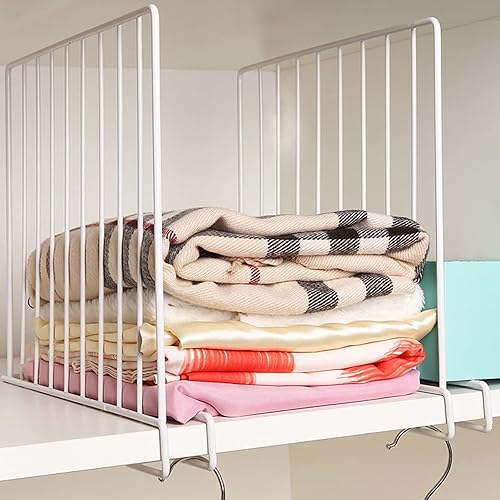
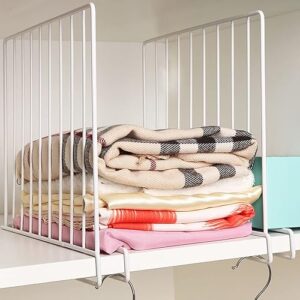
These are the dividers that most people picture when they search for shelf dividers: a simple L-shaped metal frame with a slot that slides over the edge of the shelf and a friction clamp that tightens from below. The steel is powder-coated in matte black (also available in white), which holds up well over time compared to cheaper chrome finishes that show fingerprints and rust near humidity sources like bathroom closets.
Shelf compatibility: Designed for shelves between 5/8 inch and 3/4 inch thick. The clamp slot is fixed — it does not adjust — so if your shelf is thinner than 5/8 inch the divider will rock, and if it is thicker than 3/4 inch it will not close. For standard melamine closet shelves, this fits perfectly right out of the box.
Height: 11 inches, which is appropriate for sweater stacks up to about 10 inches tall. If you stack higher than that, the pile will eventually lean over the top of the divider. For stacks of folded jeans or bulky knits, these are the right height. For folded t-shirts in a shallow shelf, they may be taller than needed.
Who this works for: Anyone with a standard builder-grade or IKEA-style closet system. The set of six covers most shelves, and the matte finish reads as intentional rather than utilitarian. Installation takes about 30 seconds per divider.
Caveat: Do not overtighten the bottom screw during installation. The metal clamp is designed to grip from friction, not from being cranked down hard. Over-tightening can bow the shelf slightly on thin MDF, which creates a visible dip over time. Snug is enough.
2. BINO Clear Acrylic Shelf Dividers — Best for Visible, Clean Organization
BINO Acrylic Shelf Dividers (Set of 4, Clear)
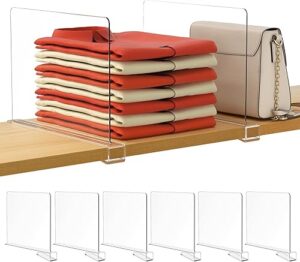
If you want to see your organization without visual clutter, clear acrylic dividers are the right call. BINO’s version is injection-molded in one piece — no separate clamp hardware that can loosen or fall off. The slot is cut directly into the base of the divider, and the acrylic is thick enough (4mm) that it does not flex when you push against it while grabbing a sweater.
Shelf compatibility: Works on shelves between 1/2 inch and 3/4 inch thick. The tolerance is slightly looser than the SimpleHouseware metal version, which makes it a better fit for shelves that land between those sizes. Not recommended for shelves thicker than 3/4 inch — the slot is cast to a fixed dimension.
Height: 10 inches. Slightly shorter than the metal option above, which makes them look cleaner on a partially-filled shelf where a tall divider would look out of proportion. At 10 inches they are still tall enough to contain a standard stack of 6 to 8 folded items.
Who this works for: Walk-in closets where aesthetics matter, open shelving that is visible from the bedroom, and linen closets where the goal is a clean, uniform look. The transparency means they disappear visually and your eye goes to the clothing, not the hardware.
Caveat: Acrylic scratches more easily than powder-coated metal, and over time light surface scratches can make the divider look cloudy. Avoid sliding rough fabric against the face of the divider repeatedly. If you tend to pull items out aggressively, the metal pick above will hold up better long-term.
3. Caroeas Wire Shelf Clip-On Dividers — Only Option That Works on Wire Shelves
Caroeas Wire Shelf Clip-On Dividers (Set of 8)
If your closet has wire shelving — the white coated wire grid commonly found in rental apartments, builder-grade closets, and ClosetMaid systems — this is the only category of divider that will actually work. Clip-on wire shelf dividers do not use a clamping slot. Instead, they hook directly onto two adjacent wire rungs on the front and back of the shelf, and a flat panel spans the gap between them as the divider surface. Caroeas makes a polypropylene version with a fabric-smooth face that will not snag on knitwear.
Shelf compatibility: Designed specifically for wire shelves. Works on shelves with wire spacing between 1/2 inch and 1.5 inches. This covers the vast majority of standard wire shelving. The clips are pre-formed to grip the wire — you hook them on and they stay put. No tools, no tightening.
Height: 9 inches. Shorter than the other picks, which is appropriate for wire shelves that are typically installed in closets with multiple shelf levels stacked closer together. They also come in a set of 8, so you can divide multiple shelves or narrow each section further on a long shelf.
Who this works for: Anyone with a wire closet system. If you are unsure whether you have wire shelves, look at the shelf from below — if you can see through it and the shelf feels like a grid, you have wire shelves and this is your product. For other shelf types in your closet (a wooden top shelf combined with wire lower shelves, for example), you may need both this and one of the above picks.
Caveat: On wire shelves with wider-than-standard wire spacing, the hooks may not engage securely. If you have an older or commercial wire system with 2-inch spacing between wires, these clips will be loose. In that case, look for dividers specifically rated for wide-wire shelving.
Once you have your dividers installed, pairing them with a hanging closet organizer for accessories and folded items that need vertical storage can give your closet a complete, layered organization system.
What We Got Wrong First
The first set of dividers we ordered for a rental apartment closet were standard metal slot dividers — the exact style in pick #1 above. They looked right, the reviews were good, and we ordered without checking the shelf type. The closet had wire shelving.
We quickly learned that a slot divider has nothing to grip on a wire surface. The divider sat balanced on the wire grid for about two minutes before we moved the first item. The moment we pulled a sweater from the pile, the divider slid sideways, toppled, and took the stack with it. We propped it back up. It fell again. We tried wedging it between the wires from below. It still had no friction, no grip, no stability.
We returned the metal dividers (Amazon made it painless) and ordered the Caroeas clip-on set instead. They hooked onto the wire rungs in about 10 seconds each, and we have not thought about them since. The lesson was simple: read the shelf type, not just the star rating. Every review for a slot divider is written by someone with a flat shelf — nobody mentions wire compatibility because it genuinely does not apply to them. The product is not flawed; it is just wrong for wire shelves.
The Contrarian Take
Shelf dividers solve a symptom, not the cause. If your closet shelf has more than five or six sweater-height stacks lined up side by side, the dividers will hold the piles upright — but you will still spend two or three minutes every morning finding the right one. You will lift the divider to pull a sweater from the middle. The stack next to it will lean. You will restack. This is not an organization problem; it is a quantity problem.
The more useful question before buying dividers is: how many of these items do you actually reach for in a given month? If the answer is fewer than half of what is on the shelf, the shelf has too many items on it. Dividers are not a substitute for editing your wardrobe — they are infrastructure for the items you have already decided to keep. Used that way, they are genuinely useful. Used as a way to store more, they just move the problem one level deeper.
If you do find that your closet needs more physical storage rather than better organization of what you have, our roundup of the best stackable shoe boxes covers how to reclaim floor and shelf space for the items that belong in boxes rather than open stacks.
Frequently Asked Questions
Do shelf dividers work on wire shelves?
Standard slot-style shelf dividers do not work on wire shelves because they need a flat, solid shelf edge to clamp onto. Wire shelves require clip-on dividers that hook directly onto the wire rungs. If you have wire shelving, look specifically for products labeled “wire shelf dividers” or “clip-on wire shelf dividers” — these are a different product category from the standard slot dividers and the two are not interchangeable.
How many shelf dividers do I need per shelf?
For a standard 36-inch wide closet shelf, two to three dividers is typical — one to anchor each end of a sweater section and one in the middle if you are dividing different item types. A general rule: one divider per stack category boundary. If you are storing sweaters on the left, jeans in the middle, and t-shirts on the right, you need two dividers. More dividers than stack boundaries adds friction without benefit.
What are the best shelf dividers for wood closet shelves?
For standard 3/4-inch wood or melamine shelves, either the SimpleHouseware metal dividers or the BINO acrylic dividers work well. The choice comes down to aesthetics: matte black metal if you want a clean, intentional look; clear acrylic if you want the dividers to disappear visually. For thicker wood shelves (1 inch or more), measure first and confirm the product’s listed maximum shelf thickness before purchasing.
Will shelf dividers damage my shelves?
Properly installed, no. Slot dividers grip by friction — they do not pierce or permanently alter the shelf surface. The only risk is overtightening the clamp on a thin or hollow-core shelf, which can cause a slight indentation on very cheap MDF. To avoid this, tighten just until the divider is snug and does not slide when you push it with moderate force. You should be able to remove and reposition dividers without leaving any visible mark.