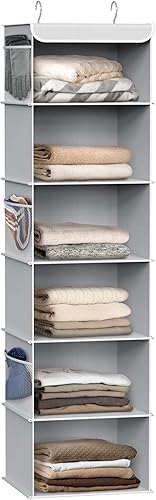
Best Hanging Closet Organizers
Most people buy a hanging closet organizer because it looks good in a photo. They pick the fabric color, count the shelves, check the price, and click buy. Then it arrives, they hang it on the rod, load it with sweaters — and three weeks later the rod is bowing, the whole section of clothing is sagging toward the center, and nothing slides smoothly anymore. That is not a defective organizer. It is a physics problem caused by buying for aesthetics instead of rod type.
USA closets have two common configurations: a single rod (the standard closet found in most bedrooms — one straight bar, one row of hanging clothes) and a double rod (the builder-grade walk-in, with a longer bar at the top and a shorter one below to double usable space). A hanging organizer adds weight to whichever rod it clips onto. If that rod is already carrying shirts and jackets, adding a six-shelf organizer stacked with folded sweaters can push the rod past the safe load for its wall brackets — which average around 35 lbs per bracket on a standard 1.25-inch closet rod.
The framework that actually works: identify your rod type and its current load before choosing anything. Then match the organizer to the rod and the clothing type you need to store. That is the order. Everything else is secondary.
Know Your Rod Before You Buy
Standard USA closet rods are 1.25 inches in diameter. That is the size almost every hanging organizer is designed to fit. If your rod is thicker — some custom closet systems use 1.5-inch or 2-inch bars — check the organizer’s listed rod diameter range before ordering, because the hook opening may be too narrow and the organizer will not hang flat.
The more important variable is load capacity. A wall-mounted closet rod bracket holds an average of 35 lbs safely, though cheaper builder-grade brackets can be lower. That load includes everything on the rod: the clothes, the hangers, and any organizer you add. A typical rod with a full section of shirts and two jackets can already be carrying 20–25 lbs before you hang anything extra. Adding a fully loaded six-shelf fabric organizer — which can weigh 8–12 lbs when filled with sweaters — pushes a borderline bracket past its limit.
To assess your current load: pull everything off a 12-inch section of the rod and weigh it on a kitchen scale. Multiply by the number of feet your rod section runs. Compare that estimate to the number of brackets and their spacing. If you have a 6-foot rod with two brackets 5 feet apart, you effectively have one bracket doing most of the work. That is a setup where a heavy shelf organizer creates a real risk.
Single-rod closets give you one zone of hanging clothes. They benefit most from a fabric shelf organizer that converts dead vertical space (the area below short items like folded shirts) into usable shelves. Double-rod closets already have two hanging levels, so they rarely need another rod extender — what they usually lack is a place for folded items or shoes, which a shelf or shoe organizer solves. If you have a double rod and are considering a rod-doubler organizer, stop: you likely do not need more rods. You need better categories.
Our Top 3 Picks
HOKEEPER 6-Shelf Hanging Closet Organizer — Best for Folded Clothes on a Single Rod
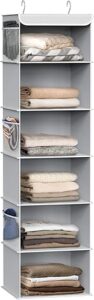
The HOKEEPER six-shelf hanging organizer is a fabric cubby system that hangs from a single hook over your closet rod and drops straight down with six open shelves for folded items. Each shelf is roughly 12 inches wide and 12 inches deep — enough for two stacks of folded sweaters or four to five folded T-shirts per shelf. The frame is reinforced with S-shaped metal ribs so the shelves hold their shape under load rather than collapsing into a hammock.
It is built for a standard 1.25-inch rod and works best in single-rod closets where there is unused vertical space below shorter hanging items. In a typical bedroom closet with shirts on one side, you can hang this organizer in the unused lower space that those shirts never reach — effectively adding 6 shelves without touching the floor. That is the correct use case. It is not designed for a rod that is already at capacity.
The organizer itself weighs about 1.5 lbs empty. Fully loaded with six shelves of sweaters it can reach 10–12 lbs. That is meaningful weight. The ideal installation is near a wall bracket — within 6 inches — so the bracket absorbs the load rather than the center span of the rod.
What to know before buying: the shelves are not zippered or enclosed, so items can shift and fall if the organizer is bumped. For loose accessories or small items, use a small bin on each shelf rather than stacking directly. Also confirm the hook gap fits your rod — most buyers report no issue with 1.25-inch rods, but some aftermarket replacement rods are slightly oversized.
Buy the HOKEEPER 6-Shelf Hanging Organizer on Amazon — a solid choice if you need to convert unused vertical space below your shorter hanging items.
StorageWorks Hanging Closet Doubler — Best for Single-Rod Closets That Need More Hanging Space
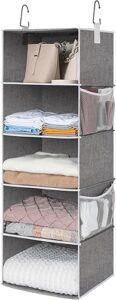
The StorageWorks hanging closet doubler adds a second hanging bar below your existing rod, effectively splitting one hanging level into two. It hooks over your existing rod, hangs down about 18 inches, and provides a second bar where you can hang shorter items — dress shirts, blazers, folded trousers on clip hangers, or children’s clothing. The bar is steel with a non-slip coating and is rated to hold up to 20 lbs of clothing.
This makes sense in a single-rod closet where you have a lot of short clothing and wasted vertical space below. A typical dress shirt hung on a standard hanger takes about 36 inches of vertical space. If your rod is 66 inches from the floor, you have 30 inches of empty air below every shirt. A closet doubler uses that space. On a double-rod closet, this organizer is unnecessary — you already have two bars.
The weight math matters here. The doubler itself weighs about 2 lbs. Add 20 lbs of clothing on the lower bar, and you have 22 lbs from this single organizer — before counting what is already on the upper rod. Only install a doubler on a rod section that is lightly loaded above, or position it directly above a wall bracket. A center-span installation on a fully loaded rod is asking for a bracket failure.
For seasonal items that eventually move out of the closet and into under-bed bags, a doubler is especially useful during transition seasons when the closet is temporarily holding more clothing than usual. We cover under-bed storage bags for clothes separately if you are ready to move truly off-season pieces out of the closet entirely.
Buy the StorageWorks Hanging Closet Doubler on Amazon — the right call when your single-rod closet has more short clothing than your single bar can organize.
MISSLO 24-Pocket Hanging Shoe Organizer — Best for Shoes and Small Accessories
The MISSLO 24-pocket hanging shoe organizer is a clear-pocket fabric panel that hangs over the back of a door or from a closet rod. Each pocket is sized for one shoe — or for accessories like sunglasses, belts rolled up, hair ties, small bags, or anything else that gets lost in drawer chaos. Twenty-four pockets across six rows of four holds a full rotation of everyday shoes for most adults without stacking.
The pockets are clear reinforced vinyl so you can see the contents at a glance without pulling anything out. The top panel has two loops for over-door hanging — the most common installation — but it also has a metal bar across the top that fits a standard closet rod if you want to hang it inside the closet rather than on a door. For closet rod mounting, hang it where you have a wide gap in clothing, close to a wall bracket.
Weight per shoe pair averages 1–2 lbs. A fully loaded 24-pocket organizer carrying 12 pairs of shoes can weigh 15–20 lbs. That is near the limit for center-span rod installation. Door installation eliminates this concern entirely and is the cleaner solution for most users. If your closet also has a stackable shoe box system on the floor, reserve the hanging organizer for the shoes you reach for daily and box up the seasonal pairs.
The organizer is also machine washable — an underrated quality for something that holds shoes. The clear pockets can cloud after repeated washing, but the fabric panel holds up well over time.
Buy the MISSLO 24-Pocket Hanging Shoe Organizer on Amazon — the most versatile pick of the three, especially if you need to organize shoes and small accessories without giving up floor or shelf space.
What We Got Wrong First
The first hanging organizer we tested was a six-shelf fabric unit, and we installed it in the middle of a rod already carrying a full section of winter coats. The organizer was empty at that point — we planned to move folded sweaters into it. Within two days of loading the sweaters, the rod had developed a visible bow at the center. The wall bracket was 4 feet away. The combined weight of the coats, the organizer, and the sweaters was well over 40 lbs at the midpoint — past the bracket’s rated load.
The fix was not a stronger organizer. It was redistributing the load: the coats moved to a different rod section near a bracket, and the organizer went into the section below the shorter shirts where the load was lighter. The bow resolved within 24 hours once the weight was off. The lesson was not to check the organizer’s weight rating — it was to check the rod’s actual load before deciding where to hang anything new.
A second mistake: we assumed the hook would fit any rod. One closet had a 1.5-inch aftermarket steel rod, and the organizer hook — designed for the standard 1.25-inch rod — sat at an angle and kept sliding toward the wall. We had to use a zip tie to keep it centered. If your closet has been upgraded with a custom or boutique closet system, measure the rod diameter before ordering.
The Contrarian Take
Adding a hanging organizer to a rod that is already full does not create more organization. It creates a more densely packed version of the same chaos, now with the added problem of a bowing rod. The real first move in any closet project is removal, not addition.
Take out 20% of what is hanging. Be honest about the items that have not moved in six months. Relocate off-season clothing to under-bed storage. Once the rod has breathing room, a hanging organizer adds genuine capacity rather than compressing what is already there. Without that first step, you are organizing around a clutter problem instead of solving it.
The same principle applies to the closet floor. A hanging organizer that frees up floor space is only useful if the floor space gets used differently — for a laundry hamper, a full closet organizer system, or simply left open so the closet feels less compressed. A hanging organizer dropped into a chaotic closet without any other change typically gets buried by the surrounding mess within a month.
FAQ
How much weight can a closet rod hold?
A standard USA closet rod — 1.25-inch steel or chrome, supported by two wall-mounted brackets — holds an average of 35 lbs per bracket under normal conditions. The practical safe load depends heavily on bracket spacing. Two brackets 4 feet apart on a 6-foot rod means the center 2-foot span is spanning unsupported. The closer a heavy load is to a bracket, the less stress it puts on the rod. Cheap builder-grade plastic brackets can fail at lower weights. If you are unsure, add a center support bracket (they cost under $10) before installing any heavy organizer.
Can hanging organizers work in a small closet?
Yes, but they work better in small closets than large ones when used correctly. A small closet benefits most from vertical space maximization, which is exactly what a shelf organizer provides. The key is picking an organizer narrow enough that it does not block neighboring clothing from sliding on the rod. A 12-inch-wide organizer leaves room on both sides for hanging clothes to move freely. Avoid organizers wider than 14 inches in a closet under 4 feet wide — they create a wall that makes the whole rod harder to use.
What is the difference between a hanging shelf organizer and a closet doubler?
A hanging shelf organizer adds horizontal shelves below the rod for folded items. A closet doubler adds a second hanging bar below the rod for hung items. Choose based on what you have more of: folded clothes (shirts, sweaters, jeans) go in a shelf organizer; hung items (short jackets, blazers, children’s clothing) go on a doubler. Many closets benefit from one of each in different rod sections rather than multiple identical organizers.
Do hanging closet organizers damage rods?
The organizer itself does not typically damage the rod — overloading does. A hook-style organizer can scratch the rod’s finish over time, especially chrome rods. If appearance matters, slip a small piece of felt or foam tape between the hook and the rod. The more common damage scenario is bracket pull-out from the wall when cumulative weight exceeds what the anchor can hold. Use wall anchors rated for the load, especially in drywall without a stud behind the bracket.
Some links in this post are affiliate links. When you buy through our links, we may earn a small commission — at no extra cost to you. We only recommend products we genuinely believe in. Read our disclosure policy.