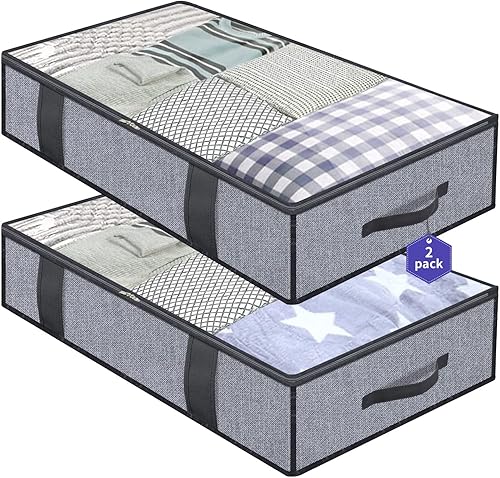
Under Bed Storage Bags for Clothes: The Right Bag for Your Climate and Garments
Under bed storage bags for clothes solve a real problem: most bedrooms have 20 to 30 cubic feet of dead space beneath the frame that goes completely unused. But grab the wrong bag type, and you may pull out mildewed sweaters six months later. This guide breaks down which bag style actually protects your clothes based on where you live and what you’re storing — because that decision matters more than brand or price.
One thing upfront: this article focuses on soft fabric bags and vacuum compression bags. If you’re looking at hard-sided options, we cover those in depth in our guide to under-bed storage bins — rigid bins with lids serve a different purpose and work best for items that need structure, not compression.
The Real Choice: Bag Type, Not Brand
Most buying guides for under bed storage jump straight to product rankings. They skip the question that determines whether any bag will actually work for you: what is the relative humidity in your bedroom? That single variable should drive your choice between vacuum compression bags and breathable fabric bags more than any review star rating.
Vacuum Compression Bags: The Space Win with a Moisture Catch
Vacuum compression bags remove air and crush bulky items to roughly 20 percent of their original size. A queen comforter that normally needs a large bin fits in a flat slab the size of a pillow. For anyone with limited under-bed clearance, that compression is genuinely useful.
The problem is what they do to moisture. Any residual dampness in a garment — even warmth from a dryer that did not fully cool before folding — gets sealed in with no path to escape. In a climate where the average summer indoor humidity runs above 55 percent, the floor-level air around your bed frame can carry enough moisture to slowly migrate through fabric fibers. Once sealed in, that moisture cannot evaporate. At 68 degrees Fahrenheit and 70 percent relative humidity, common mold species can establish on organic fabric within eight to twelve weeks, according to ASHRAE building moisture guidelines. A vacuum bag stored under a bed in Houston, coastal Florida, or the Gulf States during summer months creates exactly that environment.
The contrarian position here is worth stating plainly: vacuum bags are not always the better choice just because they save more space. For anyone in a high-humidity climate or storing natural-fiber garments like wool, cashmere, or linen, a breathable fabric bag is the safer option even though it saves less space. The internet consensus that vacuum bags are superior ignores climate entirely, which means it is wrong for a large portion of American households.
Breathable Fabric Bags: Less Compression, More Forgiveness
Non-vacuum fabric bags made from polypropylene or woven nonwoven material allow a slow exchange of air through the fabric. They will not compress a comforter by 80 percent. What they will do is let trapped moisture vapor work its way out over days rather than sealing it permanently against your garments. For seasonal clothing — t-shirts, jeans, leggings, athletic wear — stored more than four months, this breathability is worth the extra space cost.
Fabric bags also protect delicate fibers better over long storage windows. Wool and cashmere compressed at high pressure for six or more months develop flattened fiber structures that do not fully recover after unsealing. The loft that makes a sweater warm depends on those air pockets between fibers; crush them long enough and they stay crushed. Breathable fabric bags allow the fibers to sit naturally even while stored.
Seam Failure: The Failure Mode No Review Mentions
The most common real-world failure with budget vacuum bags is not mold — it is seam separation. A bag packed at maximum compression and then slid across carpet generates friction across the corners. Cheaper bags with heat-welded rather than reinforced seams develop micro-tears at the corners within a year. The bag loses its seal slowly, the contents re-expand partially, and the bag no longer fits under the bed frame. It is a gradual failure rather than a dramatic one, which is why it rarely shows up in early reviews but dominates the one-star complaints after the 18-month mark.
Our Top Picks: Under Bed Storage Bags for Clothes
1. Onlyeasy Foldable Underbed Bags 2-Pack (ASIN: B07R6H4WKL) — Best Breathable Fabric Bag
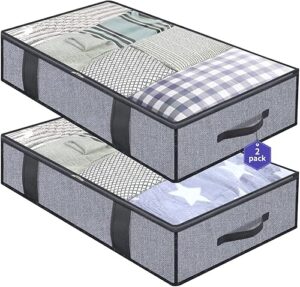
The Onlyeasy underbed bags consistently earn a 4.4-star average across more than 14,400 Amazon reviews, which reflects durable everyday performance rather than novelty satisfaction. Each bag measures 39.4 by 19.7 by 5.9 inches — long enough to slide under most queen and king frames without folding the bag awkwardly. The fabric is a polypropylene blend with a linen-like texture that allows air circulation while blocking dust and light.
The zipper is the standout feature. Onlyeasy uses a #5 metal zipper rated for more than 1,000 open-and-close cycles. Most budget fabric bags use plastic coil zippers that wear out within a season of regular access. If you are pulling out seasonal clothing twice a year, that matters less. If you are accessing work uniforms or off-season gym clothes monthly, a metal zipper will outlast the bag itself. The clear window panel on top lets you identify contents without unzipping.
This is the right pick for anyone in a humid climate storing natural fiber garments — wool sweaters, cotton oxfords, linen shirts — over a full season. It will not compress a winter wardrobe down to a thin slab, but it will keep that wardrobe intact. Four handles (two on each side) make it manageable to slide out from under beds with low clearance.
2. Zober Under Bed Storage Bags 2-Pack (ASIN: B078JJ3C61) — Best for Oversized Items
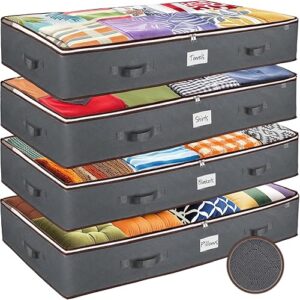
Zober’s underbed bags hold 4.4 stars across more than 20,000 reviews, making them one of the most reviewed products in this category on Amazon. Each bag measures 42 by 18 by 6 inches — slightly longer than the Onlyeasy — and the extra length matters when you are trying to fit multiple pairs of jeans flat or store a king-size comforter alongside seasonal clothing without bunching.
The material is breathable polypropylene that resists puncture and tearing better than woven fabric alternatives at a similar price. Zober uses a dual-zipper design where two separate zipper pulls run from each end, meeting in the middle — a practical choice when you need to access one side of the bag without unsealing the entire length. The clear vinyl top panel is fixed rather than zippered, so you can always see the contents even with the bag sealed.
Where Zober earns its place is with bulky mixed-fiber items: comforters, blanket sets, heavy robes, and winter coats that you need to keep accessible but do not want hanging in a packed closet. The bag does not compress aggressively, but it organizes and dust-proofs without the seam stress that vacuum-sealed options put on thick seams. For households with kids who cycle through seasonal bedding frequently, the easy-access zipper design saves real daily friction.
3. Amazon Basics Vacuum Storage Bags 12-Pack with Hand Pump (ASIN: B07RSCK4XS) — Best Vacuum Option for Dry Climates
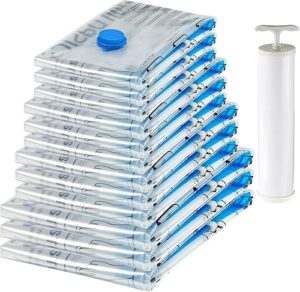
The Amazon Basics vacuum storage bag set earns its place with value-for-volume: 12 bags across four sizes (3 small at 24 by 16 inches, 3 medium at 28 by 20 inches, 3 large at 32 by 24 inches, 3 jumbo at 40 by 30 inches) plus a hand pump. That size variety is the actual advantage here. You can use the small bags for t-shirts and socks, medium for jeans and hoodies, and jumbo bags for comforters and winter coats — then stack them all flat under the bed in a way that a single large fabric bag cannot replicate.
The construction uses layered PA and PE film rather than single-layer plastic. The double-zip seal on the closure plus a triple-seal turbo valve reduces the chance of the bag slowly losing its seal over weeks, which is the failure mode that frustrates most vacuum bag buyers. The valve also accepts a standard vacuum cleaner hose, so you are not dependent on the hand pump for every use — connect your household vacuum and the bag deflates in about 30 seconds compared to two minutes with the pump.
The honest constraint: these bags are the right call only if your bedroom maintains an average relative humidity below 50 percent and you are storing synthetic or cotton-blend garments rather than wool or down. In a dry climate — Mountain West, the inland Southwest, much of the Midwest in winter — the moisture risk is negligible and the 80 percent space compression is genuinely transformative. In Atlanta in August, these bags stored under a first-floor bed are asking for trouble. Use the fabric bags instead and accept the tradeoff.
Frequently Asked Questions
Can you store clothes in vacuum bags long term under a bed?
Six months is the practical safe limit for vacuum-sealed clothing storage under a bed. Beyond that, a slow seal leak combined with any residual moisture in the fabric can lead to mildew, particularly in climates with seasonal humidity swings. For storage beyond one season, breathable fabric bags are the safer choice. If you do use vacuum bags for long-term storage, add a silica gel pack inside before sealing and check the bags at the six-month mark.
What size under bed storage bag fits a standard queen bed?
Most standard queen bed frames have 6 to 9 inches of floor clearance. A bag measuring 6 inches tall slides under a standard frame without forcing. Most fabric underbed bags from major brands — Onlyeasy, Zober, Amazon Basics — are built to the 6-inch height standard for this reason. Measure your specific frame before buying if you have a low-profile platform bed, as some frames clear only 4 to 5 inches.
Are breathable fabric bags worth the extra space cost over vacuum bags?
For natural fiber garments — wool, cashmere, silk, linen, down — yes. Sustained compression in vacuum bags can permanently flatten the fiber structure that gives these fabrics their insulating and texture properties. A cashmere sweater stored in a vacuum bag for six months may emerge thinner and less lofted than when it went in. For synthetics and cotton-blends, the compression risk is lower, and vacuum bags are a reasonable tradeoff if storage space is the priority.
How do you prevent mold in under bed storage bags?
Three steps matter: store only fully dry garments (not just feel-dry but dry overnight after washing), add a silica gel desiccant pack to each bag before sealing, and inspect bags seasonally rather than setting-and-forgetting for a full year. For vacuum bags specifically, never store items that were recently dry-cleaned without airing them out for 48 hours first — the residual solvents and any trapped moisture from cleaning create exactly the environment mold needs.
How many bags do you need for a full seasonal clothing swap?
A reasonable seasonal wardrobe for one person — roughly 6 to 8 sweaters, 4 pairs of heavier pants, 2 jackets, and accompanying accessories — fills two standard 39-by-19-inch fabric bags when folded flat. Add one bag for bedding items if you also rotate comforters seasonally. A household of two adults typically needs 4 to 6 fabric bags or an equivalent number of large and jumbo vacuum bags to cover a full off-season clothing swap without overfilling.
Some links in this post are affiliate links. When you buy through our links, we may earn a small commission — at no extra cost to you. We only recommend products we genuinely believe in. Read our disclosure policy.