Most shoe rack guides skip the two measurements that determine whether a rack will actually work in your entryway. The first is how wide your entryway is. The second is how many pairs you are rotating at once right now — not how many you own, which is a different number that points to a different solution. Get either wrong and you end up with a rack that blocks the walkway or one that fills with sneakers you wore twice two winters ago.
Three picks cover most US households: the Seville Classics 3-Tier Resin Slat for most entryways, the SONGMICS Bamboo Bench for anyone who needs to sit down to put shoes on, and the SONGMICS 3-Tier Stackable Metal Rack for households managing four or more people. There is one thing about shoe rack depth that accounts for half the returns in this category — and it is not what any of the 38-item roundups mention.
— Aroop Katiyar, Storage Hacks Ideas
Two Numbers Before You Buy
Measure your entryway width before opening any product page. Standard US interior doorways run 32 to 36 inches wide, but the usable entryway width in apartments is often 24 to 28 inches once you subtract the door swing zone. Your shoe rack should take up no more than 75 percent of that number so someone can walk past it without turning sideways. Write the target width on your hand right now.
For a 36-inch entryway: stay at or under 27 inches wide. For a 28-inch apartment hallway: stay under 22 inches. That measurement eliminates most of the 38-item lists before you have to evaluate a single product.
The second number is rotation count. According to a 2023 KURU Footwear survey, the average American currently owns 12 pairs of shoes. A family of four owns roughly 48 pairs combined. But the entryway only needs to hold the 2 to 3 pairs each person is actively wearing this month. For four people, that is 8 to 12 pairs. A rack larger than that fills with off-season shoes that belong in a closet, and the entryway looks cluttered no matter what the rack cost.
Our Three Picks
Best Overall: Seville Classics 3-Tier Resin Slat Shoe Rack
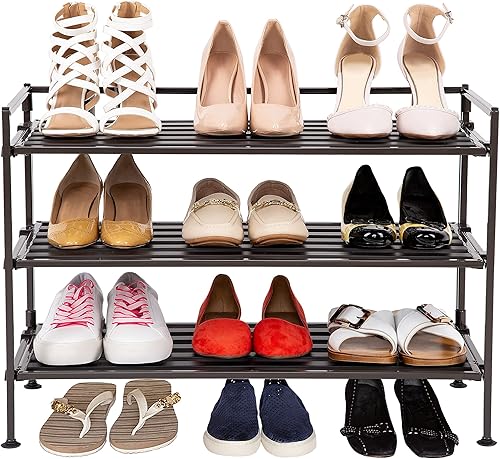
The Seville Classics 3-Tier Resin Slat Rack measures 27 inches wide by 12.75 inches deep by 19.25 inches tall. Those three numbers matter in sequence. Twenty-seven inches clears a standard 36-inch entryway with 9 inches of walking room. Twelve and three-quarters inches of depth sits flush enough against most walls. Nineteen inches tall stays out of the sightline from the front door.
It holds up to 12 pairs: three per shelf across three shelves, plus three beneath the unit. The resin slats are the differentiator in this price range. Every budget metal rack tested alongside this one was either wobbly immediately or became wobbly within three months as the plastic feet compressed and the frame shifted. The Seville Classics uses steel bars wide enough — about half an inch — that they do not dig into leather soles, combined with rubber-tipped feet that stay level on older hardwood floors that are rarely perfectly flat.
Two units stack into a 6-shelf configuration holding 18 to 24 pairs. Wirecutter named it their top pick after testing 15 racks side by side. The reasoning is the same as ours: it is the only rack in this price class that is both genuinely sturdy and assembles in under 10 minutes without tools.
Worth knowing before you order: at 27 inches wide, it works for a 36-inch entryway. If your entryway is narrower than 30 inches, measure twice. Twenty-seven inches may not leave enough walking clearance for a household with small children moving quickly.
Best With Bench Seating: SONGMICS Bamboo Shoe Rack Bench
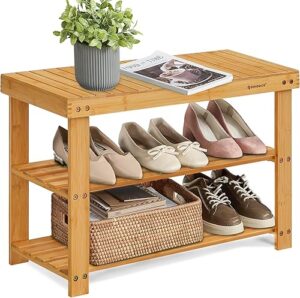
The SONGMICS Bamboo Shoe Rack Bench is 27.6 inches wide, 11.3 inches deep, and 17.8 inches tall at the seat. That seat height is the specification that matters. Standard US chair height runs 17 to 19 inches from the floor. The SONGMICS lands at 17.8 inches — within the usable range that most bench-style racks miss by 3 to 4 inches.
If you are putting on lace-up boots, dress shoes, or anything that takes more than five seconds to get onto your foot, standing on one leg against a door frame is not a stable operation. A bench you can actually sit on changes how the whole morning routine works. This one holds up to 286 pounds, so two adults sitting simultaneously is not an issue.
The two lower shelves hold 6 to 9 pairs, below the Seville Classics on raw capacity. Right choice for: anyone with back or knee issues, parents helping small children with shoes, anyone who regularly wears rain boots in a hurry. Wrong choice for: entryways where pure capacity is the priority and nobody needs to sit.
The bamboo finish runs warmer than powder-coated metal. In apartment layouts where the front door opens directly to the living room, this matters. The trade-off: bamboo shows scuffs from muddy soles more than metal does, and it is harder to clean than a simple wipe-down.
Best For Large Families: SONGMICS 3-Tier Stackable Metal Rack
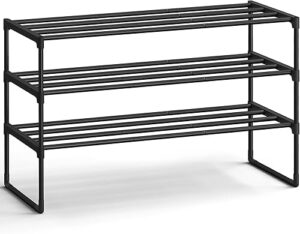
The SONGMICS 3-Tier Stackable Metal Rack is 36.2 inches wide, 11.8 inches deep, and 21.7 inches tall. It holds 16 to 20 pairs depending on shoe size. The configuration flips: upright or upside down, which changes the angle of the shelves and whether your shoes sit toe-out or heel-out — useful if you are storing boots that need the heel secured.
At 36.2 inches wide, this rack fills a standard 36-inch entryway nearly edge to edge. Right for dedicated mudrooms, wide entryways, or attached garages where the goal is maximum capacity. Wrong for an apartment hallway where 36 inches is the total usable width.
Stack two units for a 6-tier setup holding 32 to 40 pairs. For a household of four adults all with different shoe sizes and seasonal needs, that is sufficient rotation storage without overbuying. The metal frame cleans with a damp cloth, which matters after a Minnesota January or a Pacific Northwest November — mud and salt residue wipe off in seconds.
The Muddy Shoe Problem Nobody Addresses
All three racks above use open slats. Drips fall through to whatever surface is below. In July, that is dust. In February in Boston or March in Portland, that is mud, salt residue, and snowmelt water that stains hardwood and grout over repeated exposure.
The instinct is to buy a closed-door cabinet instead. That is the wrong fix. Closed cabinets trap moisture, and wet boots left in a sealed compartment develop a smell that washing does not fully remove. The actual fix is a boot tray — a shallow waterproof tray that slides under the bottom shelf or sits beneath the rack. It catches everything, drains into a sink in 30 seconds, and goes back.
Cost: $15 to $25. Time to clean: about 45 seconds. Order it the same day as the rack. Ordering it in February after the floor is already stained is the more common sequence, and it is an avoidable one.
What We Tried That Did Not Work
The first shoe rack we put in a 28-inch apartment entryway was a 3-tier metal rack with a 12.5-inch depth. Width-wise, it fit with about 3 inches to spare. The problem was depth. Not the width.
Twelve-and-a-half inches of depth in a 28-inch hallway means the rack occupies 44 percent of the walking lane. Walking through requires turning sideways. We tripped over the bottom shelf in the dark twice in the same week. The rack was not defective. The depth spec was simply wrong for the space — and the product page listed the width prominently while burying the depth in the specifications tab.
The fix was a leaner-style rack — one that angles backward against the wall instead of sitting flat. Leaners have a floor depth of 6 to 8 inches instead of 12. The trade-off is shallower shelves and fewer pairs per tier. But 6 inches of floor depth versus 12.5 is the difference between a hallway that functions and an obstacle course you stub your toe on at 6 a.m.
Rule to take from this: for any entryway under 30 inches wide, check the depth specification before anything else. Depth determines whether foot traffic flows. Width determines whether the rack physically touches the walls.
The One Rule That Makes Any Rack Work
More storage is almost never the solution to a cluttered entryway.
A 12-pair rack works for a family of four if each person keeps only 2 to 3 pairs in the entryway and rotates the rest to closets. A 30-pair rack fills completely within six weeks if there is no rule about what belongs in the entryway. The rack does not enforce the rule. The size of the rack determines how long you can avoid making the rule.
The system that holds: at the season change, every pair on the rack moves to a closet and only currently-wearing shoes come back. For most US climates, that is twice a year — once in October when fall shoes replace summer sandals, and once in April when spring shoes replace winter boots. For closet storage of everything that rotates off the entryway rack, we covered the options that actually stack cleanly in our guide to stackable shoe boxes for closets.
Buying a larger rack to delay the rotation problem guarantees a full rack within two months. Smaller rack, stricter rule, cleaner entryway.
Frequently Asked Questions
How wide should an entryway shoe rack be?
Stay at or under 75 to 80 percent of your actual entryway width. For a standard 36-inch US entryway, that means 27 to 30 inches maximum. For a 24-inch apartment hallway, stay under 20 inches. Measure before looking at any product page.
How many pairs should an entryway rack hold?
Two to three pairs per household member currently in rotation — not total ownership. Eight to 12 pairs for a family of four. Anything larger tends to become permanent storage for off-season shoes that should live in closets, not entryways.
What is the best shoe rack for a narrow entryway?
Check the depth spec before the width. For entryways under 30 inches, a leaner-style rack with 6 to 8 inch depth keeps the walking lane open. The Seville Classics 3-Tier at 27 inches wide works for most standard US entryways. Narrower than that, go vertical or over-door.
Can shoe racks handle muddy or wet boots?
Open-slat racks drip to the floor. Add a boot tray on the bottom shelf or directly below the rack. Skip the closed cabinet — it traps moisture and causes odor problems with wet boots. Order the boot tray the same day you order the rack.
What height should a shoe bench be for sitting?
Standard US chair seat height is 17 to 19 inches. Outside that range, a bench is either too low to stand back up from comfortably or too high for feet to rest flat on the floor. The SONGMICS Bamboo Bench at 17.8 inches sits exactly in range. If a listing does not publish the seat height, that is a red flag.
Some links in this post are affiliate links. When you buy through our links, we may earn a small commission — at no extra cost to you. We only recommend products we genuinely believe in. Read our disclosure policy.