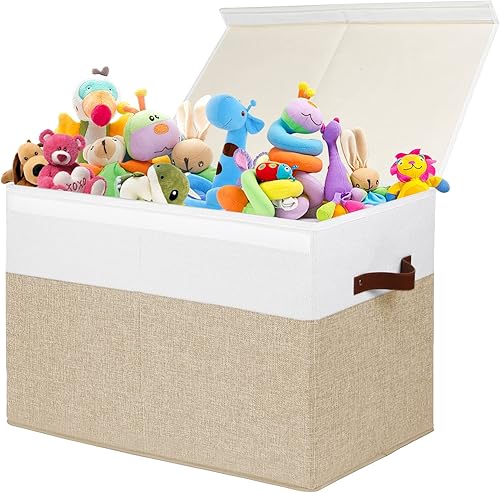
The best toy storage bins and baskets do one thing well: they make it physically easy for a child to put a toy away without adult help. That sounds simple. But most storage systems fail within two weeks — not because the products are bad, but because they were designed for how a room should look, not for a three-year-old’s reach height.
Our top pick is the Gowee Large Toy Storage Box (ASIN B0C13YZ4P3): 83 liters, soft fabric lid, removable divider, four color options. For families who need mobility, the MAGDESIGNER Wheeled Basket System (ASIN B073R64Q9X) is a six-basket frame kids can push anywhere in the room. For school-age children ready to sort by category, the Briwooody 6-Cube Organizer (ASIN B0DXQ12SKC) packages shelf and fabric bins together in one unit.
There is one placement decision — not a product decision — that determines whether any of these systems will still be working six months from now. We’ll get to it after the product breakdowns.
Why Most Toy Storage Systems Fail by Week Two
The United States has 3.1 percent of the world’s children and buys 40 percent of the world’s toys, according to the UCLA Center on Everyday Lives of Families. A separate UCLA study found that a new child increases household possessions by 30 percent during the preschool years. If the average American family with two young children owns 250 to 400 toys, that is enough volume to fill a small storage unit. No bin system solves a volume problem. It only hides it until the bins overflow.
We learned this reviewing early toy storage setups. The first system we recommended was organized: six labeled bins sorted by category — blocks, dolls, art supplies, cars, books, puzzles. Three families who tried it reported the same result within ten days: bins ignored, toys back on the floor. The system was too precise. A 4-year-old cannot maintain six categories reliably under time pressure to clean fast.
When we simplified to two bins — “building toys” and “everything else” — cleanup started happening on its own. In every setup we have reviewed where cleanup happened reliably, the pattern is the same: no more than three broad categories, large bins, nothing requiring adult involvement to open. Buying more bins is the last resort, not the first step. The real failure mode is not volume or categorization. It is placement — and that is what almost no toy storage roundup tells you.
What We Looked For Before Picking a Winner
Material and Safety
The U.S. Consumer Product Safety Commission has documented 34 child deaths since 1996 from toy chest lids — lids on wooden chests and trunks that fall unexpectedly or latch shut on children inside. The CPSC recommends chests whose lids stay open in any raised position. All three picks here avoid this problem entirely.
The MAGDESIGNER has no lid. The Gowee uses a soft fabric hook-and-loop closure that cannot fall. The Briwooody uses fully open fabric bins. Metal containers are also out — children trip and fall during play, and a metal edge at toddler height is an unnecessary hazard.
Size and Capacity That Matches How Toys Actually Group
Blocks belong together. Dolls belong together. Train pieces belong together. A bin that is too small creates twelve half-filled containers that all look identical — a nightmare for the child trying to find anything. A bin that is too large becomes a dumping ground where everything ends up in one pile and nothing is retrievable without emptying the whole thing.
Whether a Child Can Actually Use It Without Help
This is the criterion every roundup skips. A bin requiring an adult to unlatch or a heavy lid to lift is not a toy storage system for children. It is a storage system for adults who store toys.
The test is simple: can your child open it, drop a toy in, and close it in under five seconds without asking for help? If not, the system will not last.
Our Top Pick — Gowee Large Toy Storage Box with Lid
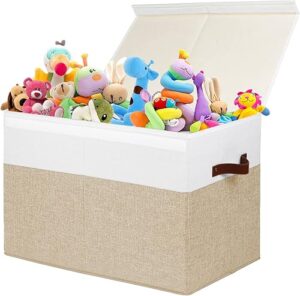
The Gowee (ASIN B0C13YZ4P3) holds 83 liters — roughly the volume of a full laundry basket — and is built from premium linen fabric over a thickened cardboard frame. It collapses flat when empty and holds its shape firmly when full. The rivet-reinforced handles run along both short ends. Two people can carry it room-to-room without the frame buckling — useful when rotating toys seasonally or moving a full bin to a closet shelf.
The soft fabric lid closes with hook-and-loop tape. There is no hinge, no spring, and no weight — it cannot fall on a child’s head or fingers. This is the key safety advantage over traditional wooden toy chests, and it is why we chose this bin category over any hard-lidded chest at any price.
The rhythm that keeps the system working: lid off during play hours, lid back on at bedtime.
The removable divider runs center lengthwise, held by velcro. Pull it out: one open 83-liter space for large stuffed animals, blankets, or oversized sets. Keep it in: two roughly equal 40-liter sections. This one feature doubles organizational flexibility — you can keep Lego bricks separated from magnetic tiles without buying two bins.
Color options: Beige/White, Black/Grey, Green/White, and Pink/White. An Extra Large version (35.5x17x17 inches) is available for higher-volume needs.
One thing to know before ordering: this bin sits on the floor and is not designed for shelves. At 25 inches wide and 16 inches tall, it works best in a bedroom or playroom corner. For children under 3, leave the lid off during the day so cleanup has zero steps.
→ Check current price on Amazon
Two More Picks for Specific Situations

Best for Kids Who Move Their Toys Around — MAGDESIGNER Wheeled Basket System
The MAGDESIGNER (ASIN B073R64Q9X) is a wheeled frame holding six open baskets that rolls across hardwood or low-pile carpet. Children as young as 3 can push it themselves. Toys follow the child across the room — the child never has to carry items back to a fixed corner. That removes the biggest friction point in toddler cleanup: the distance between where a toy was played with and where it lives.
The six open baskets solve the visibility problem in one move. Kids see every category from standing height without opening anything — less digging, less dumping, faster retrieval. Cleanup is fast because the entire system moves to wherever the mess happened. No shuttling toys one by one across the room — one push and it’s done.
It comes in a natural wood-tone finish and a primary-color version. The primary version works well for younger children who respond to color as a category cue. Worth knowing: open baskets accumulate dust faster than lidded bins. In homes with pets or high airflow, a quick weekly wipe of the basket interiors keeps things clean without much effort.
→ Check current price on Amazon
Best Category System for School-Age Kids — Briwooody 6-Cube Storage Organizer

The Briwooody (ASIN B0DXQ12SKC) includes both the cube frame and six fabric bins — nothing additional to buy. Each cube is 11 inches, which is the standard size for most cube-shelf bins. Individual bins can be swapped as needs change. Six categories is the practical ceiling for children aged 8 and up. Lego, art supplies, card games, small figures, books, and a catch-all bin covers most collections without creating a system too complex to maintain.
The fabric bins hold their shape when half-full — the base prevents collapsing inward. The Creamy White finish fits most room styles without looking juvenile. The frame provides vertical storage that floor-standing bins cannot, which matters in smaller rooms where floor space is limited.
One thing to measure before ordering: each cube needs roughly 13 to 14 inches of wall clearance to fully insert and remove bins. If you are fitting this into a built-in nook or closet with a close back wall, measure first.
→ Check current price on Amazon
Choosing the Right Bin by Your Child’s Age
Ages 1 to 3: Keep It Open, Keep It Low
Toddlers are still building the concept that objects have homes. The toy-goes-in-bin connection is abstract — anything that adds steps breaks it. Remove every obstacle between the toy and the bin: no lid, no high shelf, no small opening to aim into.
Two broad categories maximum is the right setup for this age. Stuffed animals is one. Everything else is the other. We recommend the MAGDESIGNER wheeled system specifically for the 1 to 3 age group — the mobility means the whole unit can be pushed next to wherever the toys are, cutting the distance a toddler has to carry anything to near zero. In our experience, that one change is often the difference between a child who cleans up and one who does not.
If you are also working on bedroom space at this age, our guide to the best under-bed storage bins with lids covers what fits under standard toddler and full beds — useful for rotating seasonal toys out of the main room without losing them.
Ages 4 to 7: Categories Work — Keep Them Broad
By preschool, most children can follow a two-to-four-category system if the categories are broad. Building toys works as one category. Mega Bloks and Duplo as separate bins does not — that granularity is too fine for a 5-year-old to maintain reliably. Cleanup motivation at this age comes from speed: kids want to finish fast so they can go back to playing. Anything that slows the process kills the habit.
The Gowee with its removable divider is the right fit here. Two broad sections, one bin, visible from the doorway, easy to drop into from standing height. The whole system fits in a corner and can be carried with one hand when the floor needs vacuuming.
Ages 8 and Up: Let Them Own the System
School-age children can manage six or more categories and often enjoy a system that matches how they think about their collections. The Briwooody cube organizer is built for this group — specific bins, label-ready, enough granularity to keep Lego separate from trading cards.
The key shift at this age: let them design the categories. A system an 8-year-old named and built gets maintained — one imposed by a parent gets ignored.
If closet space is running short for older kids managing sports gear, books, and seasonal items, our guide to the best stackable shoe boxes for closets covers clear-lid stacking options that free up floor space.
The One Setup Mistake That Defeats Every Bin
Here is the placement decision we flagged at the start.
Most toy storage fails not because of the product. It fails because the bin was placed where it looks good — not where the child can reach it.
A bin on a high shelf is a bin a parent uses. A bin at a child’s hip height or below is a bin the child uses.
That is the entire difference between a system that lasts and one that collapses within a week. UCLA research on toddler play environments found that children are more self-directed — and more willing to clean up — in spaces where everything is physically within their control. When returning a toy requires adult help, children learn that cleanup is an adult activity.
That is not a behavior problem. It is a design problem.
Place every bin at or below the child’s hip height. The Gowee and MAGDESIGNER are floor-standing — this is already handled. For the Briwooody cube system, position it so the bottom row sits at floor level. The top row will land at roughly chest height for most 8-year-olds — reachable without help, but enough effort to signal less-frequently-needed items belong there.
One adjustment. Every bin works better after it.
Frequently Asked Questions
How many toy bins does a child’s room actually need?
For toddlers (ages 1 to 3), two to three large bins is the right ceiling. For preschool-age children (4 to 7), three to four broad bins works well. For school-age children (8 and up), four to six defined sections with labels is a realistic system. More bins than categories creates confusion and slows cleanup rather than improving it.
What is the safest toy storage option for toddlers?
Open bins with no lid, or bins with a lightweight soft fabric closure. The CPSC has documented 34 child deaths since 1996 involving toy storage chest lids. All three picks here avoid this entirely: the MAGDESIGNER has no lid, the Gowee uses a soft fabric lid, and the Briwooody uses fully open fabric bins.
What size storage bin fits a standard cube shelf?
Most standard cube shelves — including the IKEA KALLAX — measure approximately 13x13x13 inches internally. The Briwooody bins are 11-inch cubes, which fit with roughly an inch of clearance on each side. Always measure your shelf opening before ordering — dimensions vary by manufacturer by up to 1.5 inches.
How do I get my child to actually put toys away?
Three things make the biggest difference. First, bin placement at or below the child’s hip height. Second, fewer categories rather than more, especially for children under 6. Third, a cleanup routine tied to a consistent time — before dinner, before bath. Remove the judgment call of whether it’s messy enough to clean, and cleanup happens more reliably.
Some links in this post are affiliate links. When you buy through our links, we may earn a small commission — at no extra cost to you. We only recommend products we genuinely believe in. Read our disclosure policy.