Most desk organizer guides have the same structure: a numbered list of products with brief descriptions, no real framework for which one belongs on your specific desk, and a vague closing note about staying tidy. After buying three different organizers across two years of home office work, the thing that actually solved the problem was not a better product. It was figuring out that a desk has three distinct zones, each with different access needs, and that a single organizer trying to serve all three is the reason organized desks revert to chaos within two weeks.
Three picks that cover the three zones: the SimpleHouseware Mesh Organizer for daily-use supplies, the Marbrasse 5-Tier Letter Tray for document-heavy work, and the Homde Bamboo Organizer for desks in shared living spaces where metal mesh looks clinical. There is a setup mistake that makes any of these useless regardless of price — and we will get to it before the product recommendations, because skipping it is how a clean desk stays clean for exactly nine days.
— Aroop Katiyar, Storage Hacks Ideas
The Setup Mistake That Kills Every Organizer
Research published by Princeton’s neuroscience lab found that physical clutter competes for attention in the visual cortex, measurably reducing focus and increasing stress responses. A separate study from IDC Research estimated that document-related disorganization costs information workers an average of $19,732 per year in time lost — roughly 2.5 hours per workday searching for things. Neither of these problems is solved by buying an organizer and filling it with whatever is currently on the desk.
The mistake is treating the desk as a single storage zone. It is not. Every working desk has three distinct zones with different access frequencies:
- Zone 1 — Daily use (arms-length, always accessible): pens, notepad, earbuds, phone stand. These are touched multiple times per day.
- Zone 2 — Reference (desk surface, current project): active documents, invoices, notebooks in use. These get pulled and put back throughout the week.
- Zone 3 — Occasional supplies (desk corner, monthly access): printer paper, extra batteries, spare cables, stapler. These are needed maybe once a month.
Most home office desks fail because Zone 3 items colonize Zone 1 space. The fix is not a bigger organizer. It is sorting before organizing — removing everything from the desk, deciding which zone each item belongs to, then returning only Zone 1 and Zone 2 items to the surface. Zone 3 moves to a drawer or shelf entirely.
Our Three Picks — Matched to Each Zone
Best for Zone 1 (Daily Supplies): SimpleHouseware Mesh Desk Organizer
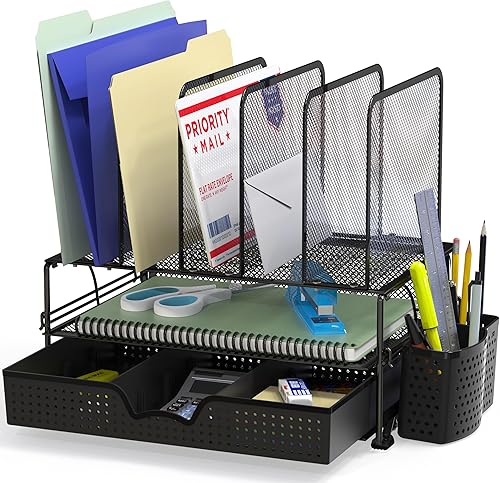
The SimpleHouseware Mesh Desk Organizer has five upright sections, a double tray, and a sliding drawer — all in one unit that sits on the desk without dominating it. Over 31,000 verified Amazon reviews at 4.7 stars make this the most field-tested desk organizer in its price range. The five upright sections are sized for pens, scissors, rulers, and phone simultaneously — the daily-use items that otherwise scatter across the surface within an hour of tidying.
The mesh construction matters for a home office specifically. A home office desk accumulates crumbs, dust, and coffee ring marks faster than a corporate desk because the space is shared with the rest of the house. Mesh cleans with a damp cloth in under a minute. Bamboo requires wood-safe cleaner and drying time. In daily use over two years, that difference adds up.
The sliding drawer handles the small items that fall through every other organizer’s system: paper clips, USB drives, sticky note pads, earbuds when not in use. The double tray section holds mail, notebooks, or a tablet. At its price point, no comparable organizer matches the combination of capacity and clean aesthetic.
Worth noting: the upright sections are 4 to 5 inches wide each. Full-size scissors and rulers fit. Standard pencil cups are narrower — if you use thick markers or design tools regularly, measure the barrel diameter before assuming they fit.
Best for Zone 2 (Document Organization): Marbrasse 5-Tier Letter Tray
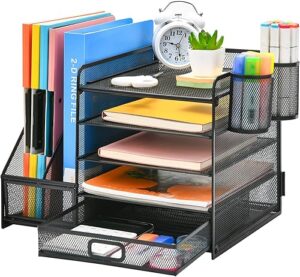
The Marbrasse 5-Tier Paper Letter Tray Organizer measures 13.8 by 11 by 12 inches and holds full US letter-size paper flat across five tiers. It also includes two hanging pen holders and one sliding drawer. Five tiers is the right number for a freelancer or remote worker managing multiple clients or active projects — one tier per project, with a sixth (the drawer) for miscellaneous items.
The problem this solves is document pile-up. Home office workers dealing with invoices, contracts, reference PDFs printed out, and current project notes typically end up with one flat stack on the desk that requires excavation every time something is needed. A 5-tier tray converts that pile into a vertical filing system where each tier has one category and retrieval takes three seconds instead of ninety.
At 12 inches tall, the Marbrasse takes up modest footprint — 13.8 by 11 inches on the desk surface — while providing vertical storage that a flat pile of papers could never match. Assembly takes about 12 minutes with the included screwdriver-free connectors. The mesh matches the SimpleHouseware unit if you use both, which keeps the desk visually consistent without intentional color coordination.
This is the wrong pick if you rarely print or file physical documents. A paperless home office — laptop only, digital filing — does not need five tiers of letter trays. Get the SimpleHouseware unit instead and skip this one.
Best for Shared Living Spaces: Homde Bamboo Desk Organizer
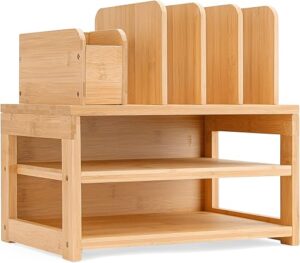
The Homde Bamboo Desk Organizer is a 3-tier natural bamboo unit with a file holder, adjustable pen sections, and a letter tray — the same functional zones as the SimpleHouseware mesh unit, but in a material that reads as furniture rather than office equipment. This distinction matters when your desk is in the bedroom, living room, or any space where an all-black metal organizer looks out of place.
Roughly 43 percent of remote workers in the US set up their home office in a bedroom or shared space, according to a 2023 FlexJobs survey. A metal mesh organizer in a bedroom next to a lamp and picture frames creates visual friction. The Homde’s natural bamboo grain blends with the room rather than announcing itself as office equipment. That is a real quality-of-life difference if you look at the desk for eight hours a day.
The adjustable pen section is the practical standout. The dividers slide to accommodate wider items — makeup brushes, design tools, a phone propped up — which makes this work for dual-purpose desks shared between work and personal use. The bamboo does not clean as quickly as mesh, and it shows moisture marks from wet mugs if you don’t use a coaster. For a dry, bedroom-based home office, those are non-issues.
What We Tried That Did Not Work
The first organizer purchased for a home office setup was a large 8-compartment unit with drawers, pen holders, and a magazine slot. Capacity for everything. It was full within 11 days.
Not full of office supplies — full of things that had no business being on a desk. Phone chargers that belonged behind the monitor. A spare set of keys. Two pens that did not work. A lip balm. Gum. The organizer did not solve the clutter problem. It gave clutter a place to live, which made the desk look tidier while making it less functional. Finding the one pen that actually worked required searching through 8 compartments every morning.
The fix was removing everything, putting only working pens and daily-use items back into a smaller 5-section organizer, and putting everything else in a drawer. Fewer compartments made the wrong items more obvious when they crept back in. A smaller organizer self-enforces the rule in a way a large organizer never can.
More Compartments Is Usually the Wrong Answer
This is the contrarian position in the desk organizer category: buying a larger, more compartmentalized organizer almost always makes desk clutter worse, not better.
A 3-to-5 compartment organizer on an edited desk keeps the wrong items visible and easy to remove. An 8-to-10 compartment organizer on an unedited desk absorbs everything — and once a compartment is full, it takes the path of least resistance to stay full. The desk looks organized. It is not. It is sorted clutter.
The edit step — removing everything and deciding what belongs on the surface before buying any organizer — is the step all the roundup articles skip. The products above work well precisely because they are sized for a sorted desk, not an overfull one. Start with the edit. Then choose the organizer that fits what remains.
Frequently Asked Questions
What is the best desk organizer for a home office?
For most home offices, the SimpleHouseware Mesh Organizer is the right starting point — it handles pens, small supplies, and phone without taking over the desk surface. Add the Marbrasse 5-Tier Tray if you deal with a lot of physical documents. Choose the Homde Bamboo version if your desk is in a bedroom or shared living space where metal mesh looks clinical.
How do I stop my desk from getting cluttered again?
Remove everything from the desk first. Only return items used at least once a week. Monthly-use items go in a drawer or shelf — not the desk surface. A smaller organizer reinforces this better than a large one, because there is physically no room for items that crept in from other zones.
Should I get mesh or bamboo?
Mesh for function — easier to clean, more durable, cheaper. Bamboo for aesthetics — better in bedrooms and shared spaces, warmer visual tone. If your home office is a dedicated room, mesh wins. If it shares space with the rest of your home, bamboo fits better.
How many compartments does a desk organizer need?
Three to five is right for most people: pens and pencils, small items like clips and earbuds, current documents or mail, and a phone stand or notepad section. More than that fills with items that should not be on the desk. Fewer than that and you are back to loose items on the surface.
What should I put in a desk organizer?
Only items used at least once a week belong on the desk surface. Pens, a notepad, earbuds, a phone stand, and current project documents are the core. Extra printer paper, spare batteries, and reference books belong in a drawer or shelf. The test: if you haven’t touched it in seven days, it belongs somewhere other than the desk.
Some links in this post are affiliate links. When you buy through our links, we may earn a small commission — at no extra cost to you. We only recommend products we genuinely believe in. Read our disclosure policy.