Best Pantry Organizer Bins: Zone First, Buy Second
The best pantry organizer bins on the market right now are the mDesign Extra Long stackable bins, the Vtopmart 6-pack clear storage set, and the OXO Good Grips bin. But the bin you buy matters far less than where you put it — most pantry reorg failures happen because people buy containers before they understand their own shelves.
Here is the honest thesis: pantry organizer bins do not create organization. They preserve it — but only if you establish use-frequency zones on your shelves first. Buy the bin before you build the zone and you will be reorganizing again in three months.
Why Most Pantry Systems Collapse Within 90 Days
ReFED’s 2025 U.S. Food Waste Report found that American households waste food worth roughly $762 per person per year — the single largest contributor to the country’s 70-million-ton annual food surplus. The root cause is not over-purchasing. It is under-visibility: food that cannot be seen gets forgotten, and forgotten food becomes waste. That stat implies that a pantry producing a family of four wastes approximately $3,000 in food yearly — nearly the cost of a month’s rent in most mid-size US cities. A well-zoned pantry bin system does not just feel tidier. It has a measurable dollar return.
The standard advice you will find on every other pantry organization list is to buy a matching set of containers, label them beautifully, and arrange them by food category — grains together, canned goods together, snacks together. This sounds logical. It does not work.
Organizing by food category ignores use frequency entirely. Your rolled oats and your specialty pasta flour both qualify as “grains,” but you reach for oats six mornings a week and touch the pasta flour twice a year. Putting them in the same zone — and the same tier of bin — guarantees that the items you grab most often are buried behind the items you barely use. You stop maintaining the system the moment it costs you fifteen extra seconds per breakfast.
The Failure Story: When the Containers Were Perfect and the System Still Broke
A specific example worth unpacking: buying an eight-piece airtight canister set, transferring every dry good into it, labeling each one in matching chalk marker, and arranging them alphabetically along a single shelf. The canisters are genuinely beautiful. Within six weeks, the “B” zone — barley, breadcrumbs, brown sugar — has become a wall blocking daily access to the coffee beans also starting with “B.” Rather than dismantle the aesthetic every morning, you leave the coffee bag on the counter. Then the olive oil. Then the instant oatmeal. Within three months the countertop has become the real pantry and the beautifully organized shelf holds things you never touch.
The containers were not the problem. Alphabetical organization is simply not a use-frequency system. It is a library system applied to a kitchen.
Zone First: The Four-Shelf Framework
Before you buy a single bin, assign each shelf of your pantry to a frequency tier. Eye level gets daily-use items — the things you touch at least three times a week. The shelf just above eye level gets weekly items. The bottom shelf gets bulk storage and seasonal items. The highest shelf, which requires a step stool, holds things you use monthly or less: specialty baking flours, bulk sugar, extra paper goods. Only after mapping these zones do you measure each shelf and buy bins sized to fit each tier’s actual contents.
This is the contrarian claim worth making plainly: the pantry organizer bin itself is the least important decision in the process. A $6 clear bin in the right zone outperforms a $40 designer bin in the wrong one. Measure your shelf depth before you order anything. Standard pantry shelves run 12 to 16 inches deep. Bins marketed as “pantry size” vary from 8 to 17 inches in length — and a bin that overhangs the shelf edge is a hazard, not a solution.
The same zoning principle applies to rotating cabinets — if you have one, a lazy susan organizer works best when each quadrant is assigned to a frequency category rather than a food type. Dead corner space becomes fully accessible when rotation is combined with a zone map.
Our Top Picks for Pantry Organizer Bins
The three bins below were selected to cover the three most common pantry shelf depths and use cases: a long narrow bin for deep shelves and daily-use groupings, a compact multi-pack for zoning a standard shallow shelf into categories, and a premium option for households that want durability and stackability without repeated replacement.
Best Overall: mDesign Extra Long Stackable Pantry Bin
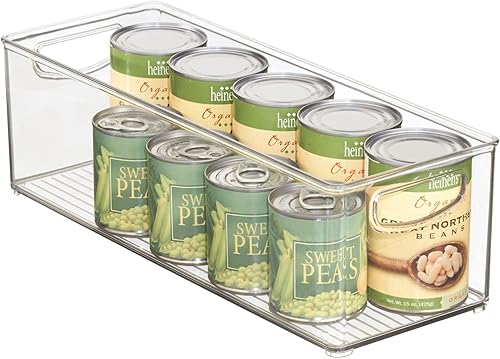
The mDesign Extra Long bin (ASIN: B07NQLDGT5) measures 16 inches long by 6 inches wide by 5 inches tall — a proportioning that solves a specific and common problem. Most pantry bins are designed for refrigerators, which run 10 to 12 inches deep. A standard pantry shelf runs 14 to 16 inches. The mDesign’s 16-inch length means it actually uses the full shelf depth rather than leaving 4 inches of wasted dead space at the back.
The material is BPA-free, shatter-resistant plastic with molded side handles that let you pull the bin out like a drawer rather than reaching behind it. It stacks cleanly due to the flat-bottomed design, which matters when you are assigning one bin per frequency zone and stacking two tiers on a single shelf. At around $10 to $14 per bin, it sits at a price point where buying four to six without hesitation is realistic for most households.
The one caveat worth naming: the clear plastic can arrive with surface scratches from shipping. Inspect on delivery. Scratched bins are functionally fine but do not maintain the visual clarity that makes the zone system work — if you cannot see what is in the bin at a glance, the system degrades. Return and replace without guilt; the product quality when undamaged is solid.
→ Check current price on Amazon
Best Value: Vtopmart 6-Pack Clear Pantry Storage Bins
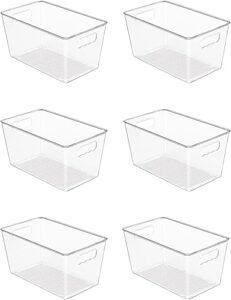
The Vtopmart 6-pack (ASIN: B08L558KX9) is the right answer when you want to zone an entire pantry in a single purchase rather than building the system bin by bin. Six medium clear bins with integrated handles, BPA-free construction, and a 4.7-star rating from over 6,000 Amazon reviews. The per-bin cost comes out to roughly $4 to $6, which makes replacing a damaged unit a non-event rather than a frustrating errand.
The medium size — roughly 10 inches long by 7 inches wide — fits shelves in the 10- to 12-inch depth range cleanly, making these the correct choice for built-in pantry cabinets rather than walk-in pantry closets. Use them to divide your eye-level daily-use zone into subcategories: one bin for breakfast items, one for snack bags, one for cooking oils and vinegars. The handles mean you can pull the entire category out onto the counter while cooking rather than rummaging around individual items.
These bins are not stackable in the traditional sense — they do not have a ridged base that locks onto a flat lid below. They can be stacked with a flat book or cutting board between tiers, but if vertical stacking without accessories is important to your setup, the mDesign or OXO option below is a better fit.
→ Check current price on Amazon
Best Premium Pick: OXO Good Grips Storage Bin
The OXO Good Grips Storage Bin (ASIN: B0GKJLJPDF) is the correct choice when durability over multiple years matters more than per-unit cost. OXO’s design standard involves soft-grip handles, rounded internal corners that make wiping out spills a single-motion task rather than a toothbrush project, and construction weight that communicates solidity without being heavy to lift. These bins do not flex when loaded with heavy canned goods the way thinner plastic bins do.
Where OXO earns its premium is in the category of pantry bins for bulk items — a 5-pound bag of rice, a full box of pasta boxes standing upright, a six-pack of canned tomatoes. The structural rigidity means the bin holds shape and does not bow outward when packed. Cheaper bins loaded this way gradually deform, which means they stop stacking flat and start requiring you to balance rather than simply place them.
The real-world case for spending more per bin is a simple calculation: if a $6 bin fails or deforms in 18 months and an $18 OXO bin lasts 5 years, the OXO costs less over that window. Buy the cheaper bin for light-use zones — snack bags, individual spice packets, tea boxes. Buy the OXO for the heavy-use bottom shelf where real load is placed on the bin daily.
→ Check current price on Amazon
How to Buy the Right Size Bin for Your Shelf
Measure your pantry shelf depth before ordering anything. Write it down. Then measure the height of the tallest item you expect to store in that zone — cereal boxes are typically 12 inches tall, canned goods 4 to 5 inches, sauce bottles 8 to 10 inches. The bin height should be low enough that the contents are visible from standing height. A bin that is taller than its contents makes the zone system invisible and therefore useless.
Shelf width matters too. A standard pantry shelf runs 24 to 36 inches wide. Divide that width by the number of categories in that frequency tier to find your bin width target. Three daily-use categories on a 30-inch shelf means each bin should be no wider than 10 inches — which is why the Vtopmart medium size (roughly 7 inches wide) allows four categories per shelf with room to pull each one forward without knocking its neighbor off the shelf.
Frequently Asked Questions
What size pantry organizer bins do I need for standard pantry shelves?
Standard pantry shelves run 12 to 16 inches deep and 24 to 36 inches wide. For deep walk-in pantry shelves, a bin 14 to 16 inches long — like the mDesign Extra Long — fills the shelf depth without wasting space. For built-in kitchen pantry cabinets that run 10 to 12 inches deep, a medium bin in the 10-inch range fits cleanly. Always measure your shelf depth before ordering: a bin that overhangs the shelf edge is unstable and a falling hazard.
Are clear or opaque pantry bins better?
Clear bins are significantly more functional for pantry use. The entire value proposition of a zoned pantry system is immediate visual identification of what zone contains which category. Opaque bins require you to read a label — which means you have to be standing close enough to read it. Clear bins let you identify contents at a glance from across the kitchen, which is the difference between a system you maintain and one you abandon. Opaque bins work in closet or garage storage where aesthetics matter more than retrieval speed. In a pantry, always choose clear.
How many pantry organizer bins do I actually need?
Count your pantry shelves, then count the use-frequency categories you identified when zoning your shelves. A typical four-shelf pantry with three to four categories per shelf needs 12 to 16 bins total. Most households over-buy and then fill bins with things that should be discarded, which defeats the purpose. Start with your eye-level daily-use shelf — buy four to six bins for that tier, implement the system, live with it for two weeks, then add bins for the next tier. Buying all bins at once before you have used the system invites the same container-first mistake the zone-first approach is designed to prevent.
What is the best pantry organizer bin for heavy items like canned goods?
For heavy items — canned goods, glass jars, full sauce bottles — choose a bin with structural rigidity rather than price-optimized thin plastic. The OXO Good Grips Storage Bin handles sustained load without bowing. Thin-walled bins deform under repeated heavy loading, which causes them to stop stacking flat and eventually crack along the handle seams. The practical rule: any bin that will routinely hold more than eight pounds of contents should be a thicker-walled option. Light items like snack bags, tea boxes, and individual spice packets can safely go in value-priced bins.
Can I use pantry organizer bins in the refrigerator and freezer too?
Yes, but verify the material rating before placing any bin in a freezer. BPA-free ABS plastic — the material used in mDesign and Vtopmart bins — handles refrigerator temperatures without warping. Freezers are more demanding: temperatures below 0°F cause some plastics to become brittle and crack. Both mDesign and Vtopmart list their bins as fridge and freezer safe, but check the current product listing before purchasing for freezer use, as formulations can change between product generations. The OXO Good Grips bin is rated for refrigerator use; verify freezer compatibility on the current listing page.
Some links in this post are affiliate links. When you buy through our links, we may earn a small commission — at no extra cost to you. We only recommend products we genuinely believe in. Read our disclosure policy.