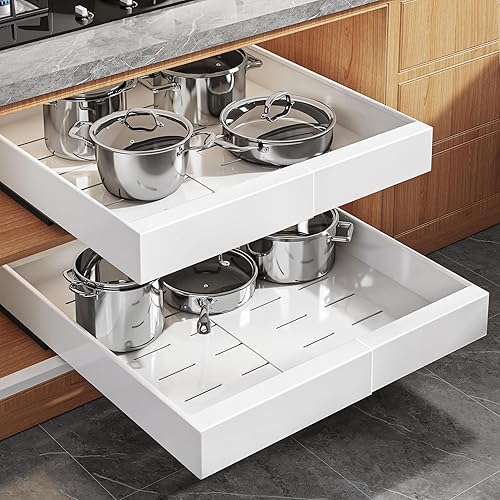
Kitchen Cabinet Organizers for Deep Cabinets: Stop Losing Things in the Back
Deep kitchen cabinets do not have a space problem. A standard 24-inch-deep base cabinet holds more than most households will ever own. The problem is retrieval — specifically, the fact that anything pushed past the front six inches becomes invisible, forgotten, and eventually expired. The right kitchen cabinet organizer for deep cabinets does not maximize storage capacity; it eliminates the blind zone entirely.
Most organization guides tell you to group items by category, use bins, and keep frequently used things up front. That advice is not wrong, but it treats deep cabinets as a depth problem when they are actually an access problem. Stack cans three deep and you have tripled your storage capacity and doubled the odds that the back row never gets touched again. The solution is mechanical, not behavioral — a system that physically delivers the back of the cabinet to you, every single time.
Why Deep Cabinets Fail: It Is Not About Space
The moment you put something behind something else in a deep cabinet, the back item effectively stops existing. A 2021 USDA study found that the average American household discards nearly $1,500 worth of food annually, and organizational researchers consistently point to “out of sight” storage as a leading cause — items stored where they cannot be seen without moving something else are used at dramatically lower rates. This is not a willpower issue. It is a visibility issue built into the geometry of standard base cabinets.
The conventional fix is to stack neatly and “use a turntable.” A lazy susan organizer genuinely helps with corner cabinets and round items like bottles and jars, and it earns its place in the deep-cabinet toolkit. But for rectangular cabinet footprints where you’re stacking pots, pantry items, or mixing bowls, turntables solve spin access while leaving the blind-depth problem fully intact. You still cannot see what is there until you crouch down and look, and you still have to remove the front row to reach anything behind it.
The Stacking Myth: More Levels, More Problems
Adding a tiered shelf riser to a deep cabinet feels productive. You get an upper level and a lower level, doubling your visible surface area. In a shallow cabinet — say, 12 inches deep — a riser works beautifully because the back is always reachable. In a 24-inch-deep cabinet, a riser creates two blind zones instead of one. The back of the lower level and the back of the upper level both require full excavation to access. You have not solved retrieval; you have stratified it.
This is the contrarian truth most deep-cabinet guides miss: organizing strategies that work brilliantly in shallow spaces actively make deep cabinets worse. Every layer added without addressing the depth is another place for items to disappear permanently. The only organizing strategy that breaks this pattern is one that converts depth into forward motion — a pull-out mechanism that brings the full interior of the cabinet to the cabinet door opening.
The Retrieval Principle: Your Cabinet Should Come to You
A pull-out organizer reframes what a cabinet is. Instead of a fixed box you reach into, it becomes a drawer that presents its full contents at the door opening. The distinction sounds obvious until you price out a kitchen renovation to add actual drawers — a full-depth drawer conversion on base cabinets runs $800 to $2,000 per cabinet with professional installation. Pull-out organizers achieve 85 to 90 percent of the same functional result for $30 to $100 per cabinet, installed in under fifteen minutes with no drilling required on current-generation adhesive models.
The specific failure story that convinced me this matters: I spent two years organizing my corner base cabinet with labeled bins, a tiered riser, and a turntable on top. Every three months I would reorganize it because items kept migrating to the back and expiring. The real problem was not my system. It was that no amount of labeling changes the physics of a fixed-shelf cabinet — if you have to move things to see things, the system requires constant maintenance to stay functional. One pull-out drawer eliminated the relabeling cycle entirely, because I could see everything without touching anything.
What to Look for in a Deep Cabinet Organizer
The single most important specification for a deep cabinet pull-out is the depth of the drawer itself. Standard pull-out organizers are designed for shallow upper cabinets and max out at 14 to 17 inches deep. In a 24-inch base cabinet, a 17-inch drawer leaves a 7-inch dead zone at the back. Look specifically for organizers rated at 21 inches of drawer depth — this covers virtually all accessible interior of a standard North American base cabinet once the door framing is accounted for.
The second specification is the rail system. Single-rail pull-outs wobble laterally when loaded unevenly, which means a cabinet full of pots and mixing bowls — all different weights on different sides — will cause the drawer to bind and drift. Three-rail systems distribute the load across three contact points and maintain alignment under real-world uneven loading. This is not a marketing upgrade; it is the mechanical reason some pull-outs stop sliding smoothly after six months and others run for 40,000 cycles without degradation.
Third: framed versus frameless compatibility. Most American kitchen cabinets are framed — they have a 1 to 1.5-inch face frame edge at the cabinet opening that the drawer must clear. A pull-out designed only for frameless cabinets will bind on the frame edge, preventing full extension. Look for models that include raising pads — small shims that lift the drawer mechanism above the frame edge so it extends fully without catching.
Our Top Picks for Deep Cabinet Organizers
Best Overall: Seinloes 2-Pack Expandable Pull-Out Cabinet Organizer (21″ Deep)
The Seinloes 2-Pack solves all three of the critical deep-cabinet specifications simultaneously. At 21 inches of drawer depth, it reaches the full accessible interior of a standard base cabinet. The three-rail slide system — reinforced at all three contact points — handles real kitchen loads without lateral drift. And it ships with raising pads specifically for framed-cabinet face frames up to 0.4 inches tall, which covers nearly all North American kitchen cabinet construction.
The width adjusts from 12.05 to 20.4 inches, which means one model fits both narrow spice cabinets and standard 18-inch base cabinets. Installation is adhesive-based with nano tape — no drilling, no hardware, no cabinet modification. The manufacturer rates the slide mechanism for over 40,000 open-close cycles, which at twice-daily use works out to over 54 years of functional life. Getting two units in a single purchase makes this the most cost-effective entry point for a full cabinet conversion.
Real-world use confirms what the specifications promise: you pull the drawer, the entire 21-inch depth of your cabinet presents itself at the door opening, and nothing requires excavation. For pantry items, mixing bowls, small appliances, or any category where the back-of-cabinet blind zone has been a persistent problem, this is the most direct mechanical fix available without a renovation.
→ Check current price on Amazon
Best for Heavy Cookware: Rev-A-Shelf 2-Tier Kitchen Cabinet Pullout (22″ Deep)
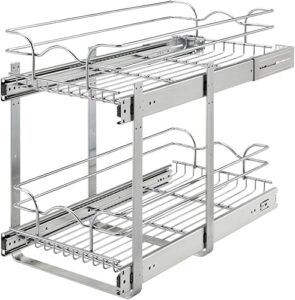
Rev-A-Shelf has been manufacturing cabinet hardware for professional kitchen installations since 1978, and the 2-Tier Pullout reflects that pedigree. Where adhesive pull-outs mount to cabinet walls, the Rev-A-Shelf mounts to the cabinet floor with four screws and uses full-extension ball-bearing slides rated for over 100 pounds per basket. That weight rating matters for cookware — cast iron skillets, Dutch ovens, and heavy ceramic baking dishes exceed what adhesive-mounted organizers are designed to hold.
The two-tier wire basket design addresses vertical space in a way single-drawer pull-outs cannot. The lower basket holds heavy items flat; the upper basket holds lids, sheet pans, or lighter items upright. At 22 inches of depth, it exceeds the Seinloes by one inch and fits the same standard base cabinets. The wire construction — chrome-plated steel — allows visual inventory from any angle, including from above, which is how most people actually look into a base cabinet.
The trade-off is installation: four screws into the cabinet floor are required, and the unit arrives fully assembled but needs alignment before securing. For renters or anyone who needs zero-trace installation, the Seinloes is the better choice. For homeowners who want a permanent, contractor-grade solution for their heaviest cabinet contents, the Rev-A-Shelf is the category winner. The 12-by-22-inch model fits a standard 18-inch cabinet with a margin for the face frame.
→ Check current price on Amazon
Best Value Set: PAKETA 4-Pack Expandable Pull-Out Cabinet Organizer (21″ Deep)
For kitchens with multiple deep cabinets — particularly common in older homes built with economy-sized base cabinet runs — buying one or two pull-outs addresses only the most painful cabinet while leaving the rest unchanged. The PAKETA 4-Pack is designed for whole-kitchen conversions: four full-depth pull-outs in a single purchase, each with the same 21-inch depth and 12-to-20-inch adjustable width as the individual models above.
The thickened carbon steel construction handles heavier loads than typical wire pull-outs in the same price tier. The three-rail system matches the Seinloes for lateral stability. Installation is the same adhesive nano-tape method — no drilling, compatible with framed and frameless cabinets. At four units per purchase, the per-unit cost drops substantially below buying individual organizers, making this the rational choice when the goal is a complete kitchen retrofit rather than a single-cabinet fix.
The practical limitation is that four identical-width organizers work best in kitchens where the cabinets are similar in size. Kitchens with highly variable cabinet widths — narrow spice cabinets alongside wide base cabinets — may find better value mixing individual units to match each cabinet’s specific dimensions. But for the typical American kitchen with a run of 15-to-18-inch base cabinets, four PAKETA units will convert the entire run in a single afternoon.
→ Check current price on Amazon
Frequently Asked Questions
What size pull-out organizer do I need for a standard deep kitchen cabinet?
Standard North American base cabinets are 24 inches deep, but the usable interior depth after accounting for the door and face frame is typically 20 to 22 inches. Look for pull-out organizers with a drawer depth of 21 inches — this hits the usable interior without bottoming out against the cabinet back or binding on the door. Models rated at 17 or 18 inches will leave a 3-to-5-inch dead zone at the rear, which defeats the purpose of a retrieval-focused organizer.
Do pull-out organizers require drilling?
Current-generation pull-out organizers use adhesive nano tape for no-drill installation. This works well for cabinets with smooth interior walls and loads under approximately 30 to 40 pounds per drawer. For heavier loads — cast iron, large ceramic, full sets of pots — a screw-mounted model like the Rev-A-Shelf is more reliable long-term. The adhesive models are ideal for renters or anyone who needs zero-modification installation; the screw models are the better permanent solution for heavy kitchen contents.
Will a pull-out organizer work in my framed kitchen cabinets?
Most pull-out organizers designed for frameless European-style cabinets will bind on the face frame of American framed cabinets, preventing full extension. The fix is a raising pad — a shim that lifts the drawer mechanism above the frame edge so it clears fully on both open and close. Models from Seinloes and PAKETA include raising pads in the box specifically for this reason. Always confirm that the model you select explicitly states framed-cabinet compatibility before purchasing.
How do I organize deep kitchen cabinets without a pull-out organizer?
The most effective non-mechanical approach is strict depth zoning: limit what you store to items that fit in the front 12 inches, and treat the back 12 inches as overflow or overflow-only storage. A turntable organizer helps with bottles and jars because spinning replaces reaching. Tiered shelf risers help with cans because they create a slope toward the front — though they require careful arrangement to avoid re-creating the blind-back problem on the riser’s own upper level. None of these approaches eliminate the retrieval problem; they reduce it to varying degrees.
Can I use a pull-out organizer in upper kitchen cabinets?
Pull-out organizers work in upper cabinets, but most upper cabinets are 12 inches deep rather than 24, so the 21-inch-deep models are unnecessary and will not fit. For upper cabinets, look for pull-out models in the 12-to-14-inch depth range, or use tiered shelf risers which function well at shallow depths. The deep-cabinet retrieval problem is specific to base cabinets — upper cabinet organization follows different principles because the shallower depth keeps items more visible naturally.
Some links in this post are affiliate links. When you buy through our links, we may earn a small commission — at no extra cost to you. We only recommend products we genuinely believe in. Read our disclosure policy.