Best Shower Organizer Caddy: Why Your Mounting Method Matters More Than Your Brand
The best shower organizer caddy for your bathroom is almost certainly not the one ranked number one on any roundup list. It is the one matched to your specific mounting surface. A $12 suction-cup caddy installed correctly on smooth glazed tile will outlast a $50 tension pole installed on an uneven tub surround. Every review skips this conversation because it is easier to rank products than to explain physics. This guide does the harder thing.
One thesis to state plainly: the mounting method is the product. Everything else—brand, finish, number of shelves, price point—is secondary to whether the mechanism works with your shower’s actual surface.
Why Shower Caddies Really Fall (And Why It’s Not the Brand’s Fault)
At 2am on a Tuesday, a shower caddy hits the floor of a tub and wakes up everyone in the house. This happens regularly in American bathrooms, and the cause is almost never a defective product. The cause is a mismatch between the mounting type and the surface it was placed on.
Suction cups fail on textured or porous tile because the cup cannot displace air through an uneven surface. Even tiles that look smooth to the eye may have micro-texture from the manufacturing process. Once air seeps back under the cup—a process accelerated by steam, soap residue, and daily temperature swings—the seal breaks. The caddy drops.
Tension poles fail differently. They are under constant upward pressure against the ceiling or the overhead wall of the shower enclosure. If that surface is not rigid—painted drywall, a thin shower panel insert, a fiberglass surround that flexes slightly—the pole gradually loses its bite. Seasonal humidity changes expand and contract the materials, loosening the tension. A pole that felt rock-solid in January may start wobbling by July.
Over-showerhead caddies carry their own failure mode: showerhead thread diameter and pipe protrusion length vary by fixture. A caddy hook that hangs securely on a standard 1/2-inch NPT showerhead arm can wobble, tilt, or swing on a rain showerhead or a handheld showerhead setup. Add a full load of product bottles and the leverage makes the problem worse.
The Honest Surface Compatibility Chart
Smooth glazed ceramic tile: works well with suction cups, tension poles, and over-showerhead styles. Glass enclosure panels: suction cups work if the glass is clean and the cup is sized correctly. Textured tile or natural stone: avoid suction cups entirely; use tension pole or over-showerhead only. Fiberglass or acrylic tub surrounds: tension poles work if the ceiling is solid; avoid suction cups on the flexible panel walls. Drywall or painted wall above the tile line: never use a tension pole here; the surface is not load-bearing.
Weight Capacity: What the Numbers Actually Mean
A full 16-ounce shampoo bottle weighs about one pound. A full 33-ounce conditioner—the size most people actually buy—weighs over two pounds. Add two more bottles, a body wash, a razor, and a loofah and you are at seven to nine pounds easily. When a caddy is rated for “up to 10 lbs,” that is the engineering maximum, not the comfortable operating load. Treat the rating as a ceiling, not a target.
The Contrarian Case Against Tension Poles for Most Renters
Conventional advice in every bathroom organization guide treats tension poles as the default renter-friendly solution because they require no drilling. This advice is not wrong, but it is incomplete. Tension poles require a rigid, flat surface at both contact points. The ceiling above a bathtub is frequently drywall or textured paint, not tile. The bottom contact point rests on the tub floor, which is curved on most American alcove tubs. The pole sits on a curved, sloped, wet surface under constant vertical pressure. This is exactly the wrong condition for long-term stability.
The better renter-friendly choice for most standard alcove tubs is an over-showerhead caddy. It borrows load capacity from the water supply pipe, which is anchored in the wall and rated to carry far more force than a caddy will ever exert. No surface compatibility issues, no floor-contact problem, no ceiling-contact problem.
Our Top Picks for Shower Organizer Caddies
These three picks cover different mounting methods and different installation scenarios. None of them are chosen for brand prestige. Each is chosen because the mechanism matches a real use case.
Best Tension Pole: Zenna Home Tension Pole Shower Caddy (ASIN: B07QMTKNQD)
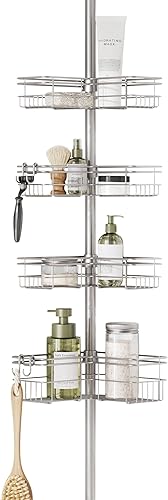
Zenna Home makes one of the most stable tension pole designs on the market, and the reason is structural rather than cosmetic. The four L-shaped baskets wrap around the corner rather than extending straight out, which distributes weight more evenly down the pole and reduces the lever-arm torque that causes competitor poles to wobble. The satin nickel finish is rust-resistant rather than merely rust-proof-in-theory—Zenna has been making bathroom tension hardware long enough that the material choices reflect real field data.
The height range is 60 to 97 inches, which covers most standard shower-over-tub setups and walk-in showers without a ceiling drop. Installation takes about ten minutes with no tools. The caveat applies here as everywhere: measure your actual floor-to-ceiling distance and confirm the bottom contact point is on a flat, non-curved surface before buying. If your tub floor curves to a drain, place a rubber non-slip mat under the pole foot.
This is the right pick for walk-in tiled shower stalls where the floor is flat and the ceiling is solid, and where you need to store four or more people’s products without running out of shelf space. Check price on Amazon.
Best Over-Showerhead: AHNR Hanging Shower Caddy (ASIN: B0BHHQ6W5B)
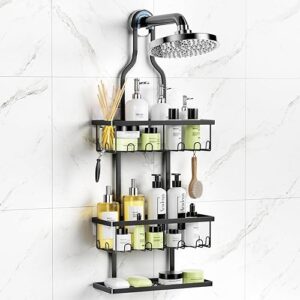
The AHNR over-showerhead caddy solves the anti-swing problem that plagues most hanging designs. Most competitors hang from a single hook and pendulum freely every time someone bumps a bottle. The AHNR uses a secondary adhesive contact point—a non-marking pad pressed against the shower wall—to stabilize the caddy without drilling. It is a simple idea that works well, and it is the reason this caddy earns consistent positive reviews from people who tried other hanging models first.
The caddy accommodates standard fixed showerheads and most adjustable showerhead arms. It is not designed for handheld showerhead setups where the arm diameter and angle differ significantly from the standard. Three baskets and 16 hooks provide more storage than the design’s compact footprint suggests. The hook top includes non-slip rubber, which matters because showerhead pipes are not always perfectly horizontal.
This is the right pick for alcove tubs with a standard showerhead, renters who cannot drill, and anyone whose tub floor is curved. It takes two minutes to install. Check price on Amazon.
Best Suction Cup: HASKO Suction Cup Shower Caddy (ASIN: B01KZ9HZTE)
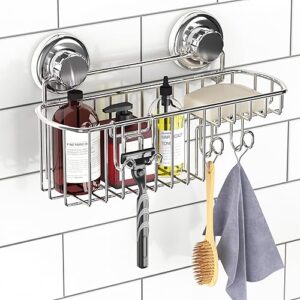
If your shower has smooth glazed ceramic tile or glass panels, a suction cup caddy is often the cleanest solution—no pole crossing the shower floor, no hardware hanging off the showerhead. The HASKO uses oversized suction cups paired with a locking lever mechanism, which creates a stronger vacuum seal than the standard press-and-hope design found on most budget suction caddies. The 304 stainless steel basket does not rust, and the chrome finish holds up better than powder-coated alternatives in the long-term steam environment of a shower.
The honest limitation is the one that applies to every suction model: it will not work on textured, natural stone, or porous surfaces. Clean the tile with isopropyl alcohol before installation, apply the cup to a dry surface, engage the lock, and give it 24 hours before loading bottles. Do not install in direct water spray path if you can avoid it—water pressure against the cup accelerates the seal degradation over time.
Pair this with a well-organized bathroom cabinet below the sink. If you are also dealing with limited cabinet space, a thoughtfully chosen under-sink bathroom organizer can handle the overflow products that do not need to be in the shower at all—which also reduces your caddy’s load and extends suction cup life. Check price on Amazon.
Frequently Asked Questions
What type of shower caddy stays put best?
The type that matches your mounting surface stays put best—not any specific brand. On smooth glazed tile, a properly installed suction cup caddy with a locking mechanism will stay put for years. On a tub floor with a flat, rigid ceiling above, a tension pole caddy is extremely stable. On any showerhead setup with a standard pipe, an over-showerhead caddy is the most reliable option because it anchors to a fixed pipe rather than relying on surface adhesion or friction against a floor.
Are tension pole shower caddies safe?
Tension pole caddies are safe when installed correctly on appropriate surfaces—a flat, solid tub floor at the bottom and a rigid ceiling or solid wall at the top. They become unstable when the floor contact is curved (as on many alcove tubs), the ceiling is drywall rather than tile, or the pole is installed at an angle rather than perfectly vertical. Follow the manufacturer’s height guidelines and confirm both contact surfaces are solid before putting weight on the shelves.
How do I keep a shower caddy from falling?
Start with the right mounting type for your surface, which is the step most guides skip. For suction cups: clean both the tile and the cup with isopropyl alcohol before installation, apply to a dry surface, and allow 24 hours before loading. Avoid installing in the direct path of the shower spray. For tension poles: install on flat surfaces, check tension monthly and re-tighten if the pole feels loose, and place a rubber mat under the base if the tub floor is slightly curved. For hanging over-showerhead caddies: use the secondary wall-contact pad to prevent swing, and do not overload the baskets beyond the weight rating.
What is the best no-drill shower caddy for renters?
For most renters with a standard alcove tub and showerhead, an over-showerhead hanging caddy is the best no-drill choice. It installs in under two minutes, leaves no marks on any surface, and does not require a flat floor contact point. Tension pole caddies are often marketed as renter-friendly, but they require the right floor and ceiling geometry to stay stable—conditions that many rental bathrooms do not meet. Over-showerhead designs borrow structural strength from the plumbing, which is always there regardless of tile type or ceiling material.
Can you use a shower caddy with a handheld showerhead?
It depends on the caddy type. Over-showerhead caddies designed for fixed showerheads typically do not fit handheld setups because the hose connection and slider bar change the geometry. For bathrooms with handheld showerheads, a tension pole caddy or suction cup caddy is a better choice. Some over-showerhead designs specify compatibility with handheld setups in their product description—check before purchasing. If your showerhead is on a slide bar, a corner tension pole in the shower stall is usually the most practical solution.
Some links in this post are affiliate links. When you buy through our links, we may earn a small commission — at no extra cost to you. We only recommend products we genuinely believe in. Read our disclosure policy.